 |
| MacDonald's sign in Cornwall, England, powered by solar and wind. The sky was rather grey that day, but the wind was blowing nicely (it was raining, too!). Pretty typical weather for Cornwall, and that wind generator was spinning like crazy! There are so many illuminated signs in non-city areas where a panel and small turbine can be mounted near an illuminated sign or on the roof of the building. So easy, so obvious, and a drop in the ocean for the budget of a major company. Yet, if everyone did it, the effect would be HUGE! Good on you McDonalds! |
Thursday, 30 July 2015
Red, Golden Arches, and Green

Nature Grows the Seed
 |
| Home-grown potatoes |
Now, three months later, the crop is ready for harvesting.
The crop is small, but then again, we started off with just ONE smallish potatoes, and now we have a pot full.
 |
| Our growing area - about 7 feet wide and 3 feet deep (215cm by 90cm) |
Friday, 3 April 2015
How much energy does YOUR house use?
A while back, I wrote a piece about the energy ratings on British houses, and I estimated our own house as being at the bottom of Band C, given our double-glazing, low-power lights, and recent condensing boiler.
So, with all that, how much energy do we actually use?
In order to know whether any energy-saving upgrades are succesful, one has to know what the relative usage over time is.
Of course, as we have "gas" heating, the biggest factor in our usage is the temeratures that a particular winter brings.
That's me.
What about you?
Do you use more or less than us
(we have a "modern", in other words "small", 2-bed semi with a conservatory, and we live in the South of England)
So, with all that, how much energy do we actually use?
 |
| Our electricity usage is fairly constant, but our gas usage shows a seasonal cycle (there is a delay in the usage and the data, as we are billed every three month, so the "Winter Bill" appears in the data just as the weather is warming up. |
Of course, as we have "gas" heating, the biggest factor in our usage is the temeratures that a particular winter brings.
That's me.
What about you?
Do you use more or less than us
(we have a "modern", in other words "small", 2-bed semi with a conservatory, and we live in the South of England)
Wednesday, 24 December 2014
Urban Deliveries - The Humble British Milk Float
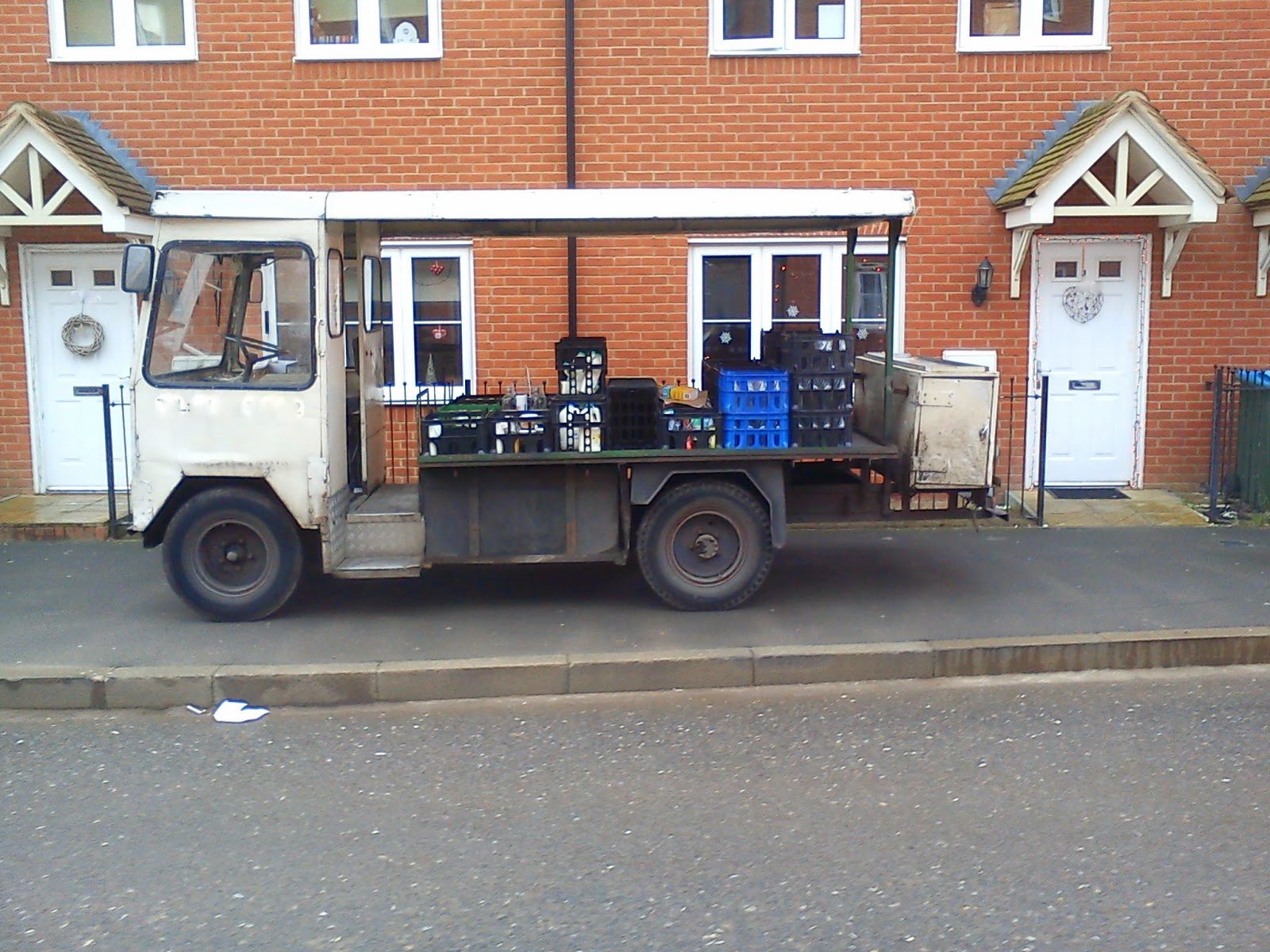 |
| The humble British Milk float, The most successful electric vehicle ever built? |
I remember growing up in the early 1970s and seeing these on the streets then.
There are a couple of variations in the design, including some with only one front wheel, and one headlight, and a more ponted front end than the squarer milk float shown above.
Sometimes petrol (gasoline) powered vehicles are used for milk delivery, particularly in rural areas, but the "classis" milk float is a battery-powered vehicle, with a string lower frame (to take the weight of the batteries!) and a lightweight upper body.
Some have plastic/grp bodywork, and some have metal bodywork, and some have side door (or no doors at all!) rather than the rear-entry cab shown above.
Such vehicles have a top speed of about 20 mph (32 km/h) and I remember cycling to work about 30 years ago on an unlit road being chased by this eerie light, I cycled faster and faster and was able to stay well in front of it. When we got to the next section of raods that had streetlights, I saw that I was being followed by a milk float (a single-headlight model).
So what is the relevance of this now?
Well, two things really:
Firstly, the electric milk float is probably THE most successful electric vehicle ever made;
Secondly, when we are thinking about how our towns and cities should be planned in the future, we need to think about what services (if any) we wish to provide.
For example, should we allow milk floats into cuty centre areas, but only before, say, 7 am?
In my experience, milk floats usually deliver somwhere between about 5 am and 7 am, 6 days a week.
Is that what we want in our cities?
Does having door-to-door milk (or whatever) deliveries mean that urban citizens cut down on car use as a result?
We discuss such things over on the Car-Free Cities community, and there is a currently a survey about ... (wait for it) ... milk floats.
Why not join us, and share your views!
Saturday, 13 December 2014
Reducing Energy Usage - A Practical Experiment
Hi all.
I thought I would share with you my thoughts on reducing energy usage.
First of all, you have to know what you are actually using.
I like tea.
A lot.
But how much energy does it cost to heat enough water for a mug of tea?
I thought I would share with you my thoughts on reducing energy usage.
First of all, you have to know what you are actually using.
I like tea.
A lot.
But how much energy does it cost to heat enough water for a mug of tea?
Domestic Solar Electricity - does anyone actually fit it?
 |
| Just a typical English street - except for the house at the back with the solar panels |
New Wind Turbine On The Edge Of Town
 |
| I was cycling out on the edge of town today, and I saw this. |
It sure looks like a wind turbine mast.
I was out on the new link road that joins Berryfields to Buckingham Park (Aylesbury), when I saw it.
A quick trawl on the internet suggests that a 2KW wind turbine was approved in March 2012, so I guess that it what is!
The wind turbine is mentioned in a document called Vale Trends, which is full of planning information for our area - but, be honest, how many folks do you think actually read such publications :-)
Iirc, about 50% of all generated electricity in the UK is lost during transport over the nation's power lines, so a modestIy-sized wind turbine close to a housing development should be quite efficient by comparison - the shorter the distance from generation to consumption, the less is lost!
The 2KW turbine is expected to supply the power to 1500 homes, but with about 75,000 folks being recorded as living in the "Aylesbury Urban Area", and I guess somewhere in the region of 30,000 to 40, 000 homes, it's not that many really!
But every bit helps.
1500 homes powered by the turbine is 1500 less from gas/oil/coal/nuclear!
And it has to be better than living next to a "regular" power station!
Subscribe to:
Posts (Atom)