|
| Nissan Leaf - the most popular electric car in the UK. |
Electric cars.
Love them or hate them, they look like they are here to stay.
With the recent changes proposed to the system for taxing motor vehicle ownership in the UK, hybrids will be taxed much more than currently, while "true" electric cars will pay no annual tax (like the rest of us do - I pay about 145 pounds (about 225 dollars, about 195 euros) a year for my "diesel" motorcar).
So how practical are electric cars?
The best-selling electric car in the UK seems to be the Nissan Leaf (although, to be fair, I did spot a pair of Teslas in a carpark in Southampton earlier in the year (Spring 2015)).
The Leaf has a renge of about 70 to 80 miles, depending on model - the earlier ones are quited at about 70 miles, while the later ones are quoted at just over 80 miles.
Given that we live about 46 miles from the centre of London (where the Leaf is exempt from paying the extra tax for pollution in the central area), that 80 mile range is a bit short ...
Some service areas on motorways (expressways/autobahns) have already got recharging points intalled for electric cars:
 |
| Electric charging pooint at Cullumpton Services, just off the M5, England |
For that trip I suggested to central London, there is a pair of charging terminals at "London Gateway" services on the M1 (It used to be called "Scratchwood Services", but I'm guessing the image consultants thought they could make it sound more important!).
London Gateway services are about 33 miles from where we live, so, for safety, if we had a Leaf, we would have to stop on both the way to London, AND the way back ...
Not so practical, methinks.
So what about the owner of the Leaf shown at the top of this piece?
Turns out he drives about 25 miles each way a day, as he works in another town, and there is a carpark near his workplace where he puts it on charge while he is at work.
Even better, electric cars in that carpark don't have to pay the normal charge for parking either!
Win, Win.
And at home?
 |
| Electic vehicle charging point on the side of a house |
Electric cars, then, seem handy for some, but not so good for others.
If we bought one and wanted to visit my father (about a 250 mile trip each way), we'd have to stop at least 4 times each way on the journey - while, if driven carefully, our diesel car will get there and back without refuelling (and a bit further, too!).
And then we must ask ourselves if electic cars are actually the solution, or is it better to use cars (of all types) less.
 |
| we don't use our car much, instead making almost all of our jouneys on foot, by bicycle, or in our daughter's case, by bus. Is this a better answer than us replacing our car with an electric one? |
If the subsidies that are being used to promote electric car ownership were used to subsidise bus and rail travel instead, then we might not even need a car at all.
Certainly heavy subsidies for the public transport systems has caused a significant drop in motor traffic before (I'm old enough to remember the "Fare's Fair" policy adopted by London up until the mid-1980's, when it was cut on political grounds, rather than economic ones - actually, that whole tier of local government of London was abolished without a vote! All part of the "Thatcher" legacy that lead to her being the first leader in 350 years where some folks held street parties to rejoice at her eventual death (but, of course, by then, she had become an irrelevance) - the politist form of description of Thatcher would be to describe her as "devisive" - she wasn't voted out either - she was replaced in a political coup by the political party of which she was the leader, so even half "her side" hated her).
Anyway, enough of the political memoir - I only put it in as a historical note for folks under 30 that belive the rubbish the right-wing print media spout about it being unworkable - it worked 35 years ago (and, as a further aside, the trains got a lower subsidy under national ownership that they do now in a "privatised" rail system, and the tickets are STILL rather expensive. But, of course, now there are shareholders who want a "profit" - even though only onle line in the country genuinely breaks even, and that is the London to Cambridge route!)
There I go with another historucal footnote.
But as they say, those who fail to learn the lessons of the past are doomed to repeat them ...
 |
| Our town, Aylesbury, is well connected by train, and with the proposed EastWest rail link it will be even better. But the trains are often a pricey way to travel, especially for two or more people who could share a car instaed! |
 |
| Our town, Aylesbury, is pretty well connected by bus, too, but the tickets are not very cheap, and the routes tend to be long and circuitous - I can cycle the 25-ish miles (about 40km) from Aylesbury to Oxford in only a bit longer than the time the bus takes to get there! And I'd save myself the price of the ticket too! (about 8 quid, 13 dollars, 11 euros) |
But as I have mentioned before, the relatively high price of public transport means that many trips are cheaper for us by car, if they are unsuitable for walking or cycling, which would be our first two choices.
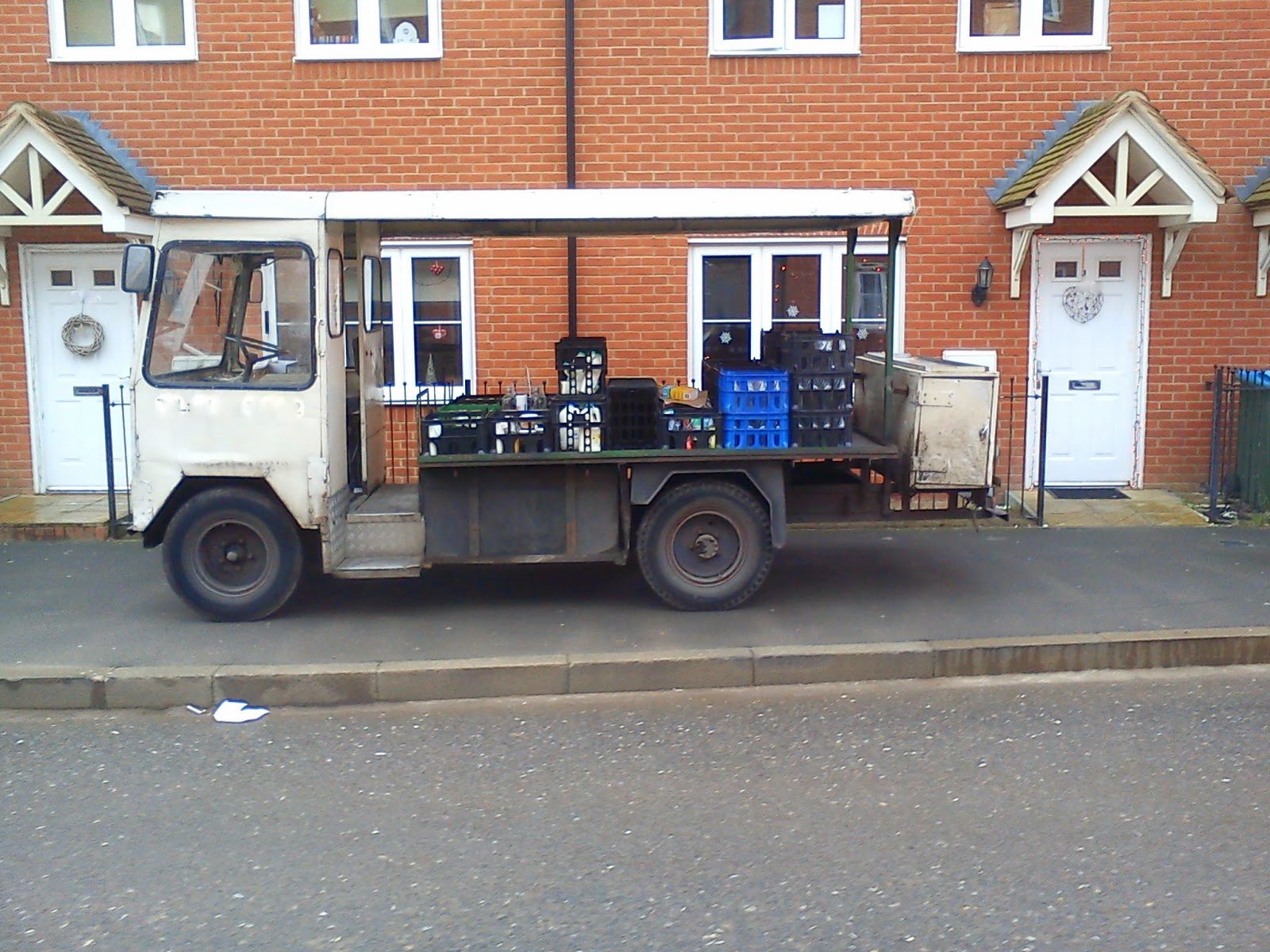
Electric vehicles have their place - commercial delivery vehicles, for example:
 |
| The "classic" British milk float - not many left now! They will go maybe 20 ,ph (32 kph) flat out, but usually travel slower. |
So that's by tuppence worth.
What do you think?
Should tax subsidies be given for electric car purchase/ownership, or should the money be used to subsidize public transport (buses and trains) instead?
Or should transport in general not be subsidized at all, and the money spent on something else (like Health, for example,), Or should it just be "given back" as a tax cut (which usually means the richest get the most back, but some folks would argue that they paid the most in the first place, and other folks would argue that they gain more from the system, so they should pay more)
What say you?
Electric cars and/or the subsuidies that go with them - Good or Bad